Search This Blog

Showing posts with label Marge Padgitt. Show all posts

Sunday, February 9, 2020

Masonry repairs should be done in the spring

By Marge Padgitt


Badly spalling bricks on a chimney
If there are pieces of bricks or stones lying around the yard or driveway, it could be a sign that masonry repair is needed. The first place to look for damages by cold, freezing rain, and wind is the chimney since it is the area most exposed to the elements.

Signs that repairs or rebuilding is needed are missing or deteriorating mortar joints, cracked bricks or stones, or faces of masonry popped off. This is due to the penetration of water into the masonry- and when water freezes it expands, which usually results in the face of a brick or stone breaking off.

Badly spalling bricks
Unfortunately, many chimneys are built with soft type bricks rather than hard type bricks due to the cost.  Soft bricks absorb moisture more easily than hard bricks. After a few years, the soft bricks will begin to show damage, but after 30 years any type of brick or stone chimney will likely show damages of some type, if only to the mortar joints.  In some cases, masons have found completely deteriorated bricks with hard mortar left behind. In other cases, the bricks are good but the mortar is severely deteriorated or missing altogether. When this occurs it is a sign that the wrong type of mortar was used.  For this reason, the Midwest Chimney Safety Council recommends that chimneys should be built or reconstructed using hard bricks and the right type of mortar which will last many years longer than those built with soft masonry units.

Mortar deteriorated so badly that
the chimney is falling apart
Mortar sets up better when the work is done in the spring when temperatures are moderate so the curing process can complete without issue. If the temperature is too cold, the mortar can crack and take a long time to cure. If the temperature is too hot the water in the mortar may migrate to surrounding masonry and shrink. Professional masons can control some of this by adding an accelerant in cold weather or soaking bricks in water before using them in hot weather, but they much prefer working with masonry in ideal weather conditions.
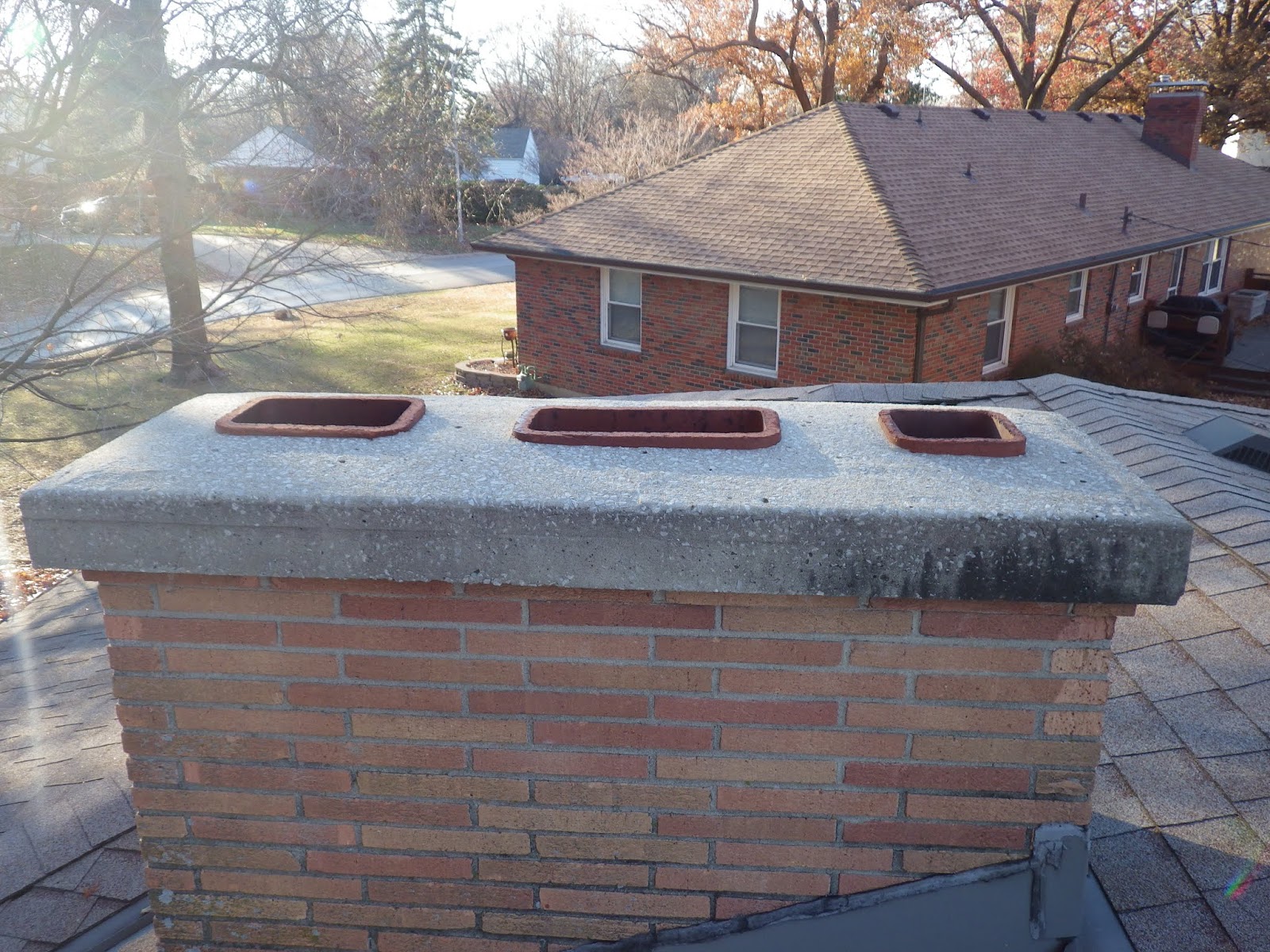
Cement cap with drip edge
The cement cap (crown) should be inspected in the spring to assure that it is in good condition with no cracks, deterioration, or lifting. The cap serves as a roof for the chimney and keeps the elements out of the interior chimney chase where rain can cause damage to the interior flue, smoke chamber, damper, and firebox. Any small cracks or gaps should be filled with high temp silicone, but if large cracks, severe deterioration, or missing sections of the cap exist a new cap should be constructed.  As of 2012, the International Residential Code required a poured formed crown with a drip edge to better protect the chimney from damaging rainwater. The old-style crowns with a slope but without a drip edge actually contribute to the fast deterioration of masonry at the top part of the chimney, so this newer style is a big improvement.
________________________________________

Marge Padgitt is the CEO of HearthMasters, Inc. and HearthMasters Education in Kansas City, Missouri. Contact her at hearthmastersboss@gmail.com

Monday, December 2, 2019

Add a mantel for a focal point in any room


Mantels are typically used above or above and surrounding working gas or wood-burning fireplaces, but more and more people are using a mantel in unique ways to add a focal point to any room. A fireplace is not needed to provide ambiance to an indoor or even an outdoor space.

Some homeowners or home decorators find antique or modern


mantels at architectural salvage stores, retail hearth stores, flea markets, antique stores, or online auction sites. Even chimney sweeps and masons may keep a few mantels around that have been removed from repair projects.

Mantels come in all styles and sizes. Small antique cast iron mantels that were once used for very small coal fireplaces are perfect for smaller spaces such as parlors, bedrooms, or foyers. Larger marble or wood mantels are appropriate to use in bigger rooms such as great rooms, family rooms or living rooms.
The outdoor room is more and more popular and outdoor fireplaces are a part of that trend. Adding a mantel to the fireplace may add just the right, and unexpected, finishing touch to the space. Protect the mantel from weather by applying a non-combustible coating to the surface if there is no roof or overhang.

Cast iron and marble mantels are non-combustible, while wood mantels are combustible, so care should be taken if planning to use a fire source. If fire is desired, an indoor gel fireplace may be added as long as clearances to combustible materials is adhered to. There are also some small depth electric fireplaces on the market that can be used if the effect is desired. Some electric fireplaces also produce a small amount of heat.
A Kansas City resident recently had five fireplaces in his historic 1870 home restored and remodeled. A local chimney contractor was able to obtain antique 1860’s period cast iron mantels from New York that fit the brick fireplaces perfectly. The small fireplaces were rebuilt with firebrick in a Rumford style, which was introduced in the 1700’s by Count Benjamin Thomas Rumford, who designed the fireplace to produce more heat. The cast iron mantels and the fireplace designs work together perfectly and appear original to the home. “I was so happy with the finished look,” said the homeowner, “We feel lucky to have been able to get the mantels shipped from New York.”

One final option that the smaller mantels can be used for is the new Bellfires brand pre-cast wood-burning zero clearance fireplace. This fireplace comes in one complete package which includes the smoke chamber and insulation with a stainless steel casing. The Bellfires wood-burning fireplace can be added to any room. A Class A stainless steel chimney is required to be installed with the fireplace. Since the Bellfires fireplace is U.L. listed it can be installed in any city per code requirements. It comes in several sizes, including a 28” high small fireplace that looks period. The cast mantels work well with this fireplace unit.
-------------------------------------------

Marge Padgitt is president and CEO of HearthMasters, Inc. and HearthMasters Education in Kansas City, Missouri. She is an author, educator, and industry veteran. www.hearthmasters.us, www.chimkc.com