|
Showing posts with label missouri. Show all posts
Showing posts with label missouri. Show all posts
Wednesday, June 7, 2017
MCSC Conference June 21-24, 2017


Saturday, September 3, 2016
Masonry Chimneys v Earthquake
By Marge Padgitt
Just after 7:00 a.m. on September 3, 2016 parts of Missouri,
Kansas, Oklahoma, Texas, Iowa, Nebraska, and Arkansas experienced a 5.7 magnitude earthquake which originated in northwest Oklahoma. The cause may be due to the
practice of disposing oil and gas field wastewater deep underground. The
temblor was similar to one experienced in the same location in November of
2011, although this recent earthquake lasted longer.
In Pawnee County, Oklahoma, the epicenter of the quake, reports damaged
masonry structures, and one man was injured when part of a fireplace fell on
him as he protected his child. In Kansas City, several reports have already
been made by homeowners who noted that their brick chimney is cracked severely.
Masonry chimneys are particularly susceptible to damage by
earthquake. Due to the nature of their rigid structure, chimneys are likely to crack while being shaken by a tremblor. Parts that
can be damaged are mortar joints inside and out, bricks, stones, blockwork, flue liners,
fireplaces, smoke chambers, and interior facial walls.
As a matter of precaution, we suggest that homeowners
inspect their chimney immediately after an earthquake, both inside and out,
then call a professional chimney sweep to do a more thorough inspection with a
chimney camera system and a keen eye trained to find things homeowners may
miss.
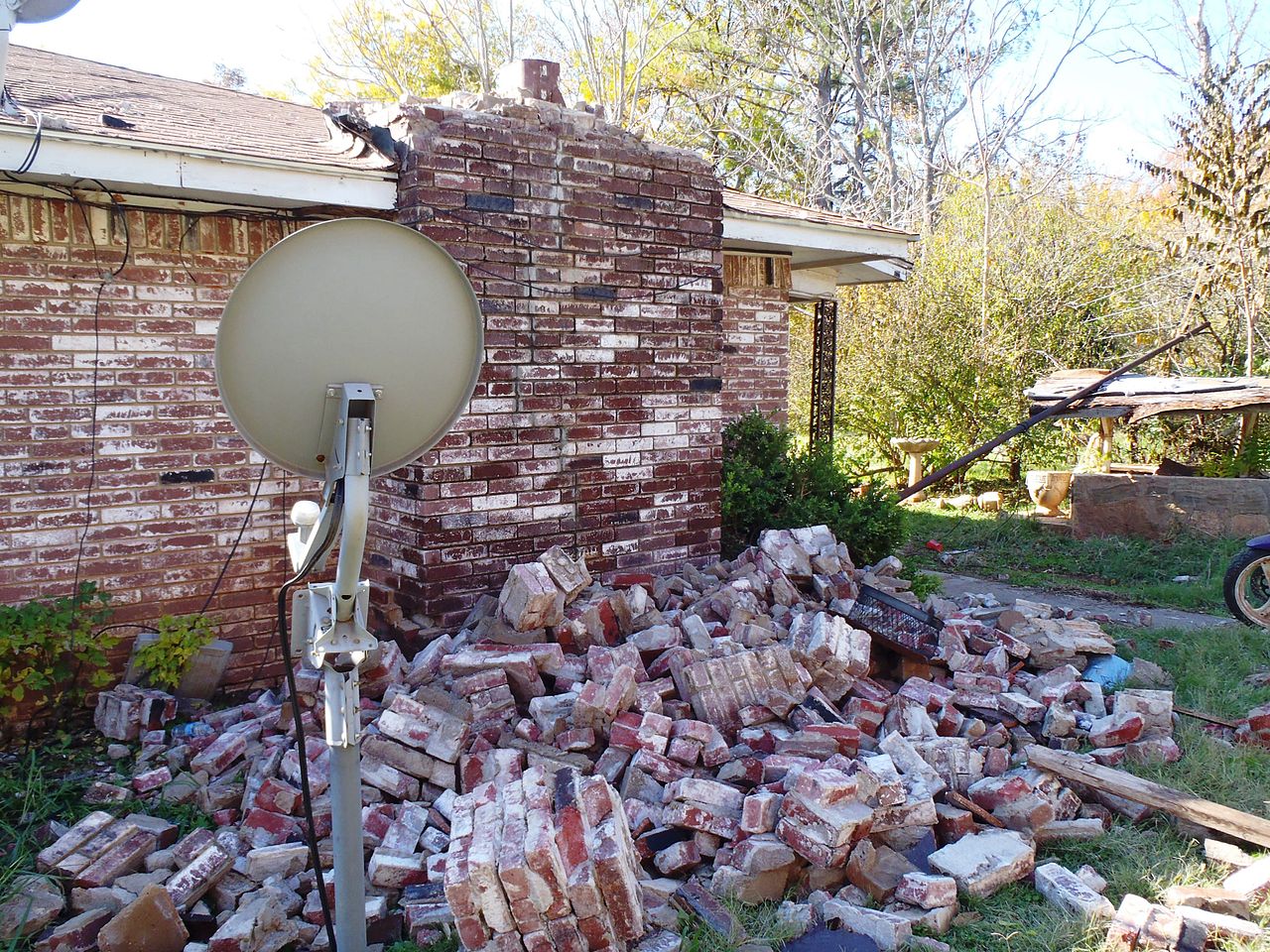 |
Photo by Brian Sherrod, United States Geological Survey - United States Geological Survey Multimedia Gallery, Public Domain, https://commons.wikimedia.org/w/index.php?curid=39847217
|
Tips:
- Look for obvious fresh clean breaks in the mortar, bricks or stone on the exterior chimney and foundation
- See if there are any pieces of masonry lying on the ground or on the roof.
- Check the facial wall inside the house above and around the fireplace opening and note any fresh breaks
- Examine the brick firebox (fireplace) and look for fresh cracks
- Take photos of your findings and note the date and time
- Have a professional chimney sweep examine the interior smoke chamber and flue liner for any fireplaces or the flue liner for the utility flue, and the entire exterior chimney after an earthquake
Chimneys on commercial buildings, churches, and schools
should be examined thoroughly by a professional immediately after an earthquake.
A damaged chimney can be a danger to occupants or passersby.
If damaged badly enough a facial wall or chimney may partially or completely fall
down. Cracks in the flue or smoke chamber can allow deadly Carbon Monoxide to
enter the interior of the house or building. CO is odorless, tasteless, and
silent. CO alarms do not alert occupants
if the air being checked is less than 9 ppm (parts per million), and it is
known that low levels of Carbon Monoxide can cause long term irreversible brain
damage. Visit www.coheadquarters.com
for more information on Carbon Monoxide.
To find a CSIA Certified Chimney Sweep in your area visit www.csia.org or www.mcsc-net.org. In Kansas City visit www.chimkc.com.
________________________________________
Marge Padgitt is a CSIA Certified Chimney Sweep, NFI Certified Woodburning Specialist, and is a 30-year industry veteran. She is an author and speaker, and CEO of HearthMasters, Inc. in Kansas City. Contact her at margepadgitt@comcast.net or 816-461-3665.
Monday, December 15, 2014
MCSC Offers Educational Classes March 20-22
The Midwest Chimney Safety Council is Holding Educational Classes
Friday, March 20 through Sunday, March 22, 2015 in Independence, Missouri

Friday:
8:00 a.m.—6:30 p.m.
CDET Certification: Get yourself and your employees C-Det Certified and learn what you don’t know about dryers, dryer vents, and the lucrative dryer vent cleaning and inspection market. Keep ahead of the competition with this additional credential!
To Register: Go to www.csia.org/cwt/external/wcpages_csia/certification/c-det_in-person_reviews.aspx to pay and register for the CDET review and test and purchase your manual. Get your manual NOW to study before the review. The MCSC is NOT taking registrations or payment for this portion.
Saturday:
8:30 am—5:30 pmWhat Every Contractor Needs to Know About OSHA Requirements
Avoid heavy fines and possible financial ruin by attending this class. A Midwest chimney company recently had over $40,000 in fines—don’t let this happen to you! Learn what you need to know about OSHA safety requirements on the job and record keeping requirements for 2015. Bring your employees and safety manager along with you!
Instructor: Robert M. Kellogg, MS, CSP, CHST, CSM, CSSM, CSST with Safety Consulting & Training Services, LLC
Sunday:
9:00 am—10:30 am
How to Use FLIR Technology for Inspections
Find out how you and your techs can use a FLIR infrared camera to check for leaks and other issues with fireplaces and chimneys and more. Connect E-Series cameras to smartphones and tablets with a Wi-Fi app. Stream live thermal video so co-workers can watch along. Import radiometric JPEGs, adjust contrast and color, add more measurement tools, then package images in concise reports and email findings right from the field to expedite critical decisions. This is the latest in high-tech and can be very useful in your business and at home. Technical CEU’s will be applied for. Instructor: Roy Huff with the Snell Group.
Find out how you and your techs can use a FLIR infrared camera to check for leaks and other issues with fireplaces and chimneys and more. Connect E-Series cameras to smartphones and tablets with a Wi-Fi app. Stream live thermal video so co-workers can watch along. Import radiometric JPEGs, adjust contrast and color, add more measurement tools, then package images in concise reports and email findings right from the field to expedite critical decisions. This is the latest in high-tech and can be very useful in your business and at home. Technical CEU’s will be applied for. Instructor: Roy Huff with the Snell Group.
11:00 am—12:30 pm
Reducing Stress in the Workplace
How about learning some unique and fun techniques to reduce stress in the workplace, which is something we all need? Health CEU's will be applied for.
Instructor: Alice Brink
How about learning some unique and fun techniques to reduce stress in the workplace, which is something we all need? Health CEU's will be applied for.
Instructor: Alice Brink
12:30 pm Lunch and meeting
Visit www.mcsc-net.org for more information and to download the registration form.
Thursday, June 26, 2014
Missouri Says No to Blanket EPA Regulations on Wood-burning Appliances
Governor Jay Nixon signed legislation Friday prohibiting the Department of Natural Resources from regulating wood-burning heaters, unless specifically authorized by the Missouri Legislature.
The legislation was introduced in an attempt to prevent Missouri from
helping implement a proposed rule change by the federal Environmental
Protection Agency. That proposal would give manufactures five years to
meet tougher standards reducing emissions from wood stoves by an
estimated 80 percent.
The EPA's existing regulations implemented in 1988 caused emissions to be reduced by as much as 70% due to the use of new technology, and don't apply to all of the different kinds of wood-burning devices now in use. Older stoves sold prior to 1989 produced emissions of 20-40 grams per hour. Today's stove emissions are 1.9 - 4.6 grams per hour, which is a significant reduction that likely can't be reduced. The new regulations are so strict, that manufacturers may not be able to meet the guidelines.
Manufacturers have said the EPA proposal would drive up their costs and force them to raise prices to a point where many consumers could no longer afford to purchase their products.
Wood stove bill HB1302 sponsored by Representative Tim Remole, and co-sponsored by Paul Fitswater specifies that Missourians have the right to heat their homes and businesses using wood-burning furnaces, stoves, fireplaces, and heaters. The bill becomes effective on August 28, 2014.
In part, the Bill reads "New rules or regulations shall not be applied to existing wood burning furnaces, stoves, fireplaces, or heaters that individuals are currently using as their source of heat for their homes or businesses. All wood burning furnaces, stoves, fireplaces, and heaters existing on August 28, 2014 shall be not subject to any rules or regulations enacted after such date. No employee of the state or state agency shall enforce any new rules or regulations against such existing wood burning furnaces, stoves, fireplaces, and heaters."
The Midwest Chimney Safety Council says that this is good news for homeowners who wish to heat their homes with wood and for businesses that service chimneys, fireplaces, and wood-burning stoves. If wood-burning were to be drastically reduced or eliminated thousands of jobs would be lost in the hearth sales, stove manufacturing,and chimney service industries
in Missouri.
.JPG) |
| High-efficiency freestanding Wood-burning stove |
The EPA's existing regulations implemented in 1988 caused emissions to be reduced by as much as 70% due to the use of new technology, and don't apply to all of the different kinds of wood-burning devices now in use. Older stoves sold prior to 1989 produced emissions of 20-40 grams per hour. Today's stove emissions are 1.9 - 4.6 grams per hour, which is a significant reduction that likely can't be reduced. The new regulations are so strict, that manufacturers may not be able to meet the guidelines.
Manufacturers have said the EPA proposal would drive up their costs and force them to raise prices to a point where many consumers could no longer afford to purchase their products.
Wood stove bill HB1302 sponsored by Representative Tim Remole, and co-sponsored by Paul Fitswater specifies that Missourians have the right to heat their homes and businesses using wood-burning furnaces, stoves, fireplaces, and heaters. The bill becomes effective on August 28, 2014.
In part, the Bill reads "New rules or regulations shall not be applied to existing wood burning furnaces, stoves, fireplaces, or heaters that individuals are currently using as their source of heat for their homes or businesses. All wood burning furnaces, stoves, fireplaces, and heaters existing on August 28, 2014 shall be not subject to any rules or regulations enacted after such date. No employee of the state or state agency shall enforce any new rules or regulations against such existing wood burning furnaces, stoves, fireplaces, and heaters."
The Midwest Chimney Safety Council says that this is good news for homeowners who wish to heat their homes with wood and for businesses that service chimneys, fireplaces, and wood-burning stoves. If wood-burning were to be drastically reduced or eliminated thousands of jobs would be lost in the hearth sales, stove manufacturing,and chimney service industries
in Missouri.
Wednesday, March 21, 2012
Historic Chimney Restoration Work
Most homeowners and contractors are not aware that training in Historic Chimney and Fireplace restoration is limited, and there are very few masons and/or chimney contractors who do this type of work across the U.S. Many contractors and masons are not aware of the International Residential Code requirements or NFPA 211 Standards for Chimneys and Fireplaces - or that each city has its own set of rules. Additionally, the original look of the exterior chimney and fireplace must be retained, not only for aesthetics but for Historic Preservation guidelines, which is outside the scope of standard modern masonry training.
 |
| The Olson Home in Marshall, MO |
The mason you hire for the project must have OSHA approved scaffolding and fall protection, which unfortunately, many contractors don't have. Working on tall chimneys is not for everyone - so you want to work with a contractor who is used to working at heights.
Historic masonry style, bricks, and mortar - are much different now than they were in the 1700's and 1800's. The main difference is that lime mortar was used with very thin "butter" joints. The mortar was often dyed to match the bricks for a more pleasing appearance. Typically, chimneys were built with "Little Reds" style bricks, which are still available in limited supply from brickyards that keep historic bricks on hand. These bricks are no longer made.
 |
| Close up of one chimney on the Olson home |
Tips for planning historic chimney restoration:
- Hire a professional chimney inspector to inspect all chimneys, flues, fireplaces, wood stoves, or gas appliances once a year and at the time of purchase of a home. Home inspectors do not normally get the necessary training in this area that Chimney Safety Institute of America Certified Chimney Sweeps do. Home Inspectors do not normally have the proper equipment to perform an adequate chimney inspection. The interior of chimneys cannot be evaluated with the naked eye, so a Chim-Scan camera is used.
- Get recommendations for repair options from the chimney inspector, who will also likely do repair work. Be sure to check credentials and insurance. Other credentials to look for when hiring a chimney contractor are National Fireplace Institute Certifications in Wood and/or Gas. Ask to see samples of their work and a list of references where work on historic chimneys was performed.
- The item most often needed when doing historic chimney restoration work is a chimney flue liner. Liners are required by code and must be a U.L. Listed and/or approved product. Types of flue liners vary from stainless steel, custom stainless steel, and Ceramic poured systems (as seen on This Old House). Clay tile liners are generally no longer used in restoration work due to the difficulty in getting them installed properly and the fact that there is no warranty on the materials by the manufacturers. Clay tiles break when chimney fires occur, whereas stainless steel or ceramic flue liners can withstand temperatures up to 2100 degrees for at least ten minutes without failing.
- Look for a contractor who has experience in building Rumford fireplaces or installing Bellfires fireplaces if you want an open wood-burning fireplace, or someone experienced in gas or wood-burning appliance installation. The Rumford fireplace was designed in the 1700's by Count Rumford and is very efficient, and clean burning. This open fireplace actually produces heat and is very efficient. You can find a Rumford fireplace builder at www.rumford.com. The Bellfires fireplace is a pre-cast product designed after the Rumford and is manufactured by Sleepy Hollow Chimney Supply. Sleepy Hollow only sells to dealers so you'll need to find a local dealer to do the installation.
- Look for a contractor who is specifically skilled in historic masonry restoration and ask to see photos of their work and references.
- Your city may also require that the contractor have a Master Mechanical License. Ask for proof of this license. The contractor must pull the permit for the work in most cases.
-There are many options for historic fireplace restoration available now, including historic style mantels, open historic yet functional Rumford style fireplaces, historic look wood stove inserts and freestanding stoves, and closed direct vent gas fireplaces with an historic look.
- As with any contractor, ask for certificates of insurance for Worker's Comp and Liability, proof of any Certifications, MM License and work samples.
Links with more information:
Midwest Chimney Safety Council: www.mcsc-net.org (The MCSC does historic chimney restoration seminars)
Hearth, Patio, and Barbecue Association: www.hpba.org (find a list of certified installers and list of manufacturer websites here)
Chimney Safety Institute of America: www.csia.org (list of Certified Chimney Sweeps)
Thelin period look Wood and Gas freestanding stoves: www.thelinco.com - and find a list of dealers on their site
Hearthstone period look gas fireplace inserts: www.hearthstonestoves.com - and find a list of dealers on their site
Subscribe to:
Posts (Atom)