Search This Blog

Wednesday, September 2, 2015

National Chimney Safety Week brings needed awareness to the public


For National Chimney Safety Week September 9 to 18, 2015 the Midwest Chimney Safety Council reminds homeowners and restaurant owners to be diligent about maintaining their chimneys serving fireplaces, furnaces, boilers, wood stoves, and restaurant ovens.
fotolia.com


The United States Consumer Product Safety Commission released the latest statistics for residential structural fires which indicates that 21,200 hostile fires were attributed to fireplaces, chimneys or chimney systems in 2012, with an average of 22,700 occurring annually from 2010 to 2012.  According to the National Fire Protection Association in 2011 heating equipment was involved in an estimated 53,600 reported U.S. home structure fires, with associated losses of 400 civilian deaths, 1,520 civilian injuries, and $893 million in direct property damage. 

While these numbers continue to decline due to public-awareness efforts by the Midwest Chimney Safety Council, the Chimney Safety Institute of America, chimney sweep companies and firefighters, the message is still not getting to everyone. 

Mr. Charles Stanley of Lee's Summit, Missouri experienced a chimney fire in early 2015. "I didn't know that a chimney flue needed to be swept at all, much less annually. I burned wood in the fireplace for eleven years without having it swept out, but after an experience like this I won't forget to have the chimney cleaned," said Stanley. The fire was contained to the chimney structure, which sustained over $20,000 in damages. A local chimney company removed the damaged flue liner and installed a replacement liner, then repaired damaged bricks on the interior and exterior chimney. Charles said that had he known that chimneys needed regular service he could have avoided the chimney fire. 

From the NFPA
The National Fire Protection Association recommends annual inspection of flues of all types that serve gas or wood-burning appliances, and sweeping as necessary to remove flammable creosote. Creosote should be removed when ¼” has accumulated on the flue walls. Depending on the amount of wood burned restaurant ovens usually need monthly or bi-monthly sweeping, open fireplaces typically need annual sweeping, and wood stove flues and chimneys may need sweeping two or three times during the burning season.

Creosote accumulates when any type of wood is burned including hardwoods. Gas appliances don’t produce creosote, however, the flue needs to be in good condition or it could be a carbon monoxide hazard. Common issues with gas flues are gaps or cracks in flue liners, clogs in liners, and missing flue liners. Correct flue sizing is critical to proper operation. This is something a professional chimney sweep can check when doing an inspection.

The MCSC recommends that a professional chimney sweep who is certified by the Chimney Safety Institute of America do the inspection and sweeping. CSIA Certified Chimney Sweeps are trained in sweeping methods, inspections, codes, and clearances. The proper equipment is needed to do a thorough inspection and remove creosote, which involves a chimney camera system and other tools of the trade.

There are now over 1,500 CSIA Certified Chimney Sweeps across the United States with more added annually. To find a professional chimney sweep visit the Midwest Chimney Safety Council website at www.mcsc-net.org or the Chimney Safety Institute of America website at www.csia.org.

_________________
Marge Padgitt is the president of the Midwest Chimney Safety Council and a 30+ year industry veteran. She is a CSIA Certified Chimney Sweep and NFI Woodburning Specialist. Contact Marge at margepadgitt (at) comcast.net. 


Sunday, July 26, 2015

Home Buyer Beware!

Buyer beware: always have chimneys inspected by a professional chimney sweep

The Midwest Chimney Safety Council recommends an inspection of all chimneys and flues at the time of purchase of a home by a professional chimney sweep.  Home buyers may be in for a big surprise and major expense if they don’t have an inspection completed prior to closing of the sale.
Home inspectors do not inspect the interior or exterior chimney as a normal part of a home inspection. Most home inspectors do not have the necessary equipment or training to do chimney inspections, therefore, it is wise to have a professional do the job.

Unfortunately, many home buyers have found out after the sale that their chimney or fireplace is unusable. A typical inspection of a masonry chimney will reveal that the interior flue has missing mortar joints due to exposure to rain, moisture and acidic flue gasses. The older the home, the more likely there are problems.

In many cases, the seller has had a chimney fire without knowing it, and the interior clay tile flue liner is cracked and broken. Other typical findings are damaged smoke chambers, rusted dampers, missing chimney covers, poor flashing, and damaged cement crowns. Issues at the top of the chimney can’t be viewed without using a ladder, or in some cases, scaffold. Home inspectors don’t normally climb ladders or own scaffold.

The average chimney repair job runs into thousands of dollars. In the greater Kansas City area, the average relining job which involves removal of the damaged liner, scaffolding, and installation of a new flue liner costs between $8,000 to $18,000.  In a recent case, an inspection of five chimneys and eight fireplaces in one home revealed $50,000 in damages.

In a 2012 transaction in Kansas City Missouri, the seller had a chimney flue relined with a new flue liner but the installer put a liner in that was too small. Months later, when the new owner started a fire in the fireplace it smoked badly and caused smoke damage to the entire home. An inspection by a professional chimney sweep revealed that the liner installed was too small for the chimney to draft properly. Because the contract was with the previous owner, the new owner had no recourse and had to pay $14,000 to have the steel liner extracted, then the old tile liner extracted, and a new properly sized flue liner installed. Flue sizing is extremely important to the operation of the appliance and if not done correctly can cause major problems such as smoking, odors, and Carbon Monoxide back up.
If damages are found prior to closing the buyer will know exactly what condition the chimney and fireplaces are in and how to proceed with the negotiation. If damages are due to a chimney fire the seller’s insurance will cover the damages, however, it is wise for the buyer to choose the company who will do the work because sellers usually want to go the least expensive route and often hire unqualified chimney companies to do the work.

A typical Level II inspection with an internal chimney camera involves running the camera through the damper and into the smoke chamber, then the flue. This type of inspection can reveal damages to masonry, mortar joints and flue tiles that can’t be seen using the naked eye and a mirror. A professional chimney sweep who has been trained in this type of inspection will be able to identify potential hazards, fire risks, and Carbon Monoxide risks.

The MCSC recommends that all flues be inspected including fireplace flues, furnace and boiler flues, and chimneys serving wood and gas stoves and inserts. If a chimney flue has an accumulation of creosote, the creosote must be removed so that the inspector can see the flue liner. Creosote is very flammable and should be removed by a qualified chimney sweep.


Visit www.mcsc-net.org or www.csia.org for more information or to find a CSIA Certified Chimney Sweep.  


____________________________________________________

Marge Padgitt is the editor of Wood-Fired Magazine, and CEO of a chimney contracting company in Kansas City, MO. Visit www.chimkc.com for more information. 

Choose and store wood correctly

Choosing the right type of wood and drying it properly is important to the operation and performance of a wood-burning appliance. Green firewood may contain 50% or more water by weight. It produces less heat because heat must be used to boil off water before combustion can occur. Green or wet wood also produces much more smoke and creosote than dry wood. For these reasons—never burn wet wood.

Firewood should always be purchased dry or allowed to dry before burning. The best way to assure this is to purchase or cut it down it at least six months in advance and leave it in the woods, then stack it and leave for another six months so you know it is dry. Leaving the cut wood in the woods for six to twelve months allows the oils to dissipate and any bugs or critters will leave the wood and not travel home with you.
Stack wood in an area that gets a lot of sunlight rather than shade. Orient wood so that the cut ends face the direction of the prevailing wind. In the Unites States wind usually moves from west to east but if you live in a valley it may be different based on warm air rising, so face wood in the direction the deer move.
Be mindful of what your woodpile looks like as the neighbors may complain to the city if it is unkempt, or offer praise your it is straight and neat. If you really want to impress passersby, stack the wood in a cool design (there are some amazing creations on the internet).
The woodpile should be kept off of the ground to avoid rot. This can be accomplished by using bricks, blocks, or treated 4 x 4’s placed  lengthwise on the ground.
Arrange wood with gaps between the pieces so that air can circulate. Stack split pieces bark side up to shed moisture. To support the pile use a purchased holder or standing trees, fence posts, or rebar driven into the ground. Stack in one log thick ricks for faster drying. The old myth about keeping the wood pile some distance away from any buildings to avoid termites and carpenter ants is not true. The queen lives underground and without her the critters are harmless. However, brown recluse spiders do love woodpiles so that is reason enough for me to keep the wood pile at least 25’ from the house. Always use gloves to handle wood to avoid an unwelcome bite.
Be sure to make a roof of some type, whether from a tarp or even a roof built of shingles to keep water and snow off of the wood, keeping in mind that the sides need to be open to allow for air movement. More industrious wood burners may want to build a more sturdy and permanent structure with posts and a roof.
When bringing wood indoors for use, leave it near the stove or fireplace for a couple of days to further remove moisture (keep wood at least 36” away from the opening).
The difference between soft woods such as fir, cedar, or alder and hard wood such as white oak, mulberry, or walnut is density. The heavier hard woods contain more heat per volume, therefore less wood is needed and loading (putting wood on the fire) is needed less often. This is especially important for wood-burning stove users because the burn time is longer.
Some firewood dealers sell "mixed hardwood" or mixed soft and hardwood” firewood. This may or may not be desirable, depending on the proportion of low- density hardwoods that are included., so be sure to ask what types of woods will be in the mix. Softwoods are less desirable, so the price will be less than hardwoods.
When purchasing firewood be sure to ask if you are getting a full cord, face cord, rick, or pickup load as the volume varies greatly. A full cord measures eight feet wide by four feet deep and four feet high and is 128 cubic feet in volume.     
Firewood has been bought and sold this way since colonial times. A face cord, sometimes called a rick, measures eight feet wide by four feet high by depth depending on cut length. Cut length is usually 12—18” long. You may request cut length at the time of purchase to fit your stove.   
A pickup load is generally 64 cubic feet in volume depending on if it is stacked or piled in. A randomly piled load will have less wood content. Ask the wood dealer if he will split the wood for you and if not, you will need to split the larger pieces so they will dry out properly.

Basically, all wood has the same BTU’s per pound, but serious wood-burners who use an appliance such as a wood-burning stove or masonry heater burn hardwoods which offer a longer burn time and less time splitting. Hedge and Hemlock are not recommended due to the amount of sparks emitted. Hedge burns very hot and can damage wood-burning stoves. If you must use hedge, mix with other wood types.
To be sure wood is dried to 20% or less moisture content use an inexpensive moisture meter to test it. If no meter is available bang two pieces of cut wood together. If they sound hollow and loud, the wood is dry. If the sound is a low thud the wood is still wet.
You’ll need an ax, a set of splitting wedges, and a maul in order to split your own firewood. To make the task easier, purchase a manual or hydraulic log splitter ($40—$200), or a gas-powered long splitter ($1,000 +).

Make kindling by splitting some cordwood up into very small pieces. Dry pine is great for kindling purposes. Fatwood is a very good fire starter with only 2-3 pieces needed to start a fire using one match. Fatwood is derived from the heartwood or center of pine trees and is loaded with pine resin which is very flammable. Harvest fatwood from the center of pine stumps or purchase from hearth dealers or chimney sweeps. 
______________________________________________
Marge Padgitt is the publisher of Wood-Fired Magazine, and CEO of a chimney contracting company in Kansas City, Missouri. Her website is www.chimkc.comwww.chimkc.com 

Monday, June 15, 2015

Spring preparation tips for wood burners

As difficult as it is to think about cold weather during the nice spring and summer months when the trees are green and the flowers are in full bloom, wood burners need to start prepping for fall now.
Since wood needs to be cut, split and stacked months in advance so that it dries out properly, now is the time to get that project completed, and get some exercise to boot. There are several types of log-splitters available that can make the job much easier. Prices range from $150 for a hand-operated splitter, to $3,000 for a professional gas splitter.

Fotolia.com 
Wood should be stacked off the ground, away from the house, with a covering over the top but not on the sides-- so wind can blow through and dry the wood out. For the serious wood-burner, a wood shed with a permanent roof will offer years of protection from the elements. Wood should be kept away from the house because creepy crawlies like brown recluses like to hide in between the logs. Check wood with an inexpensive moisture meter to be sure it contains less than 20% moisture content before burning.

Any dry wood will do- but hardwood will burn for a longer time since it is denser than softwood. By using hardwood less time is involved in loading up the wood stove or fireplace insert, but softwoods will burn nicely. Stay away from dry pine and hedge, however, because they burn so hot and fast there is a greater risk of a chimney fire or damaging a wood stove or fireplace.

Another maintenance task that should be completed in the spring is chimney sweeping. The Midwest Chimney Safety Council suggests that a professional CSIA Certified chimney sweep do the job. Professional sweeps are trained to check things that the layperson may not be aware of such as proper chimney and connecting pipe installation, clearances to combustibles, wall and floor protection. If used for primary heating purposes, wood-burning stoves and insert flues or chimneys should be swept at least twice during the wood-burning season and once after to be sure that flammable creosote is removed.

Chimney sweep at work. HearthMasters, Inc. 
All wood creates creosote- even dry hardwood, and removal is critical to avoid chimney fires. Chimney fires can not only damage chimneys and connecting pipes, but may escape into the home and cause a house fire.

Check exterior masonry chimneys in the spring for damaged, missing, or spalling bricks (brick faces popping off due to moisture penetration), missing or deteriorated mortar joints, bad flashing or gaps in the flashing, cracked or deteriorated cement crown, and missing or improper chimney covers. Apply masonry water repellant sealer on a dry, calm day to help slow down the deterioration process.
For a prefabricated chimney check the wood chase for wood rot, holes from woodpeckers or squirrels, rusted metal chase tops, and damaged chimney covers.

All of these chimney maintenance items are best addressed in the spring and summer before cold weather sets in and makes work more difficult and expensive.


Tuesday, March 24, 2015

Is your chimney tall enough to work right?


By Marge Padgitt

Fireplaces and wood-burning stoves only work right when everything is built or installed correctly, and that includes the height of the chimney. There are several factors to take into consideration when planning for the termination height of a masonry or factory built chimney system. 

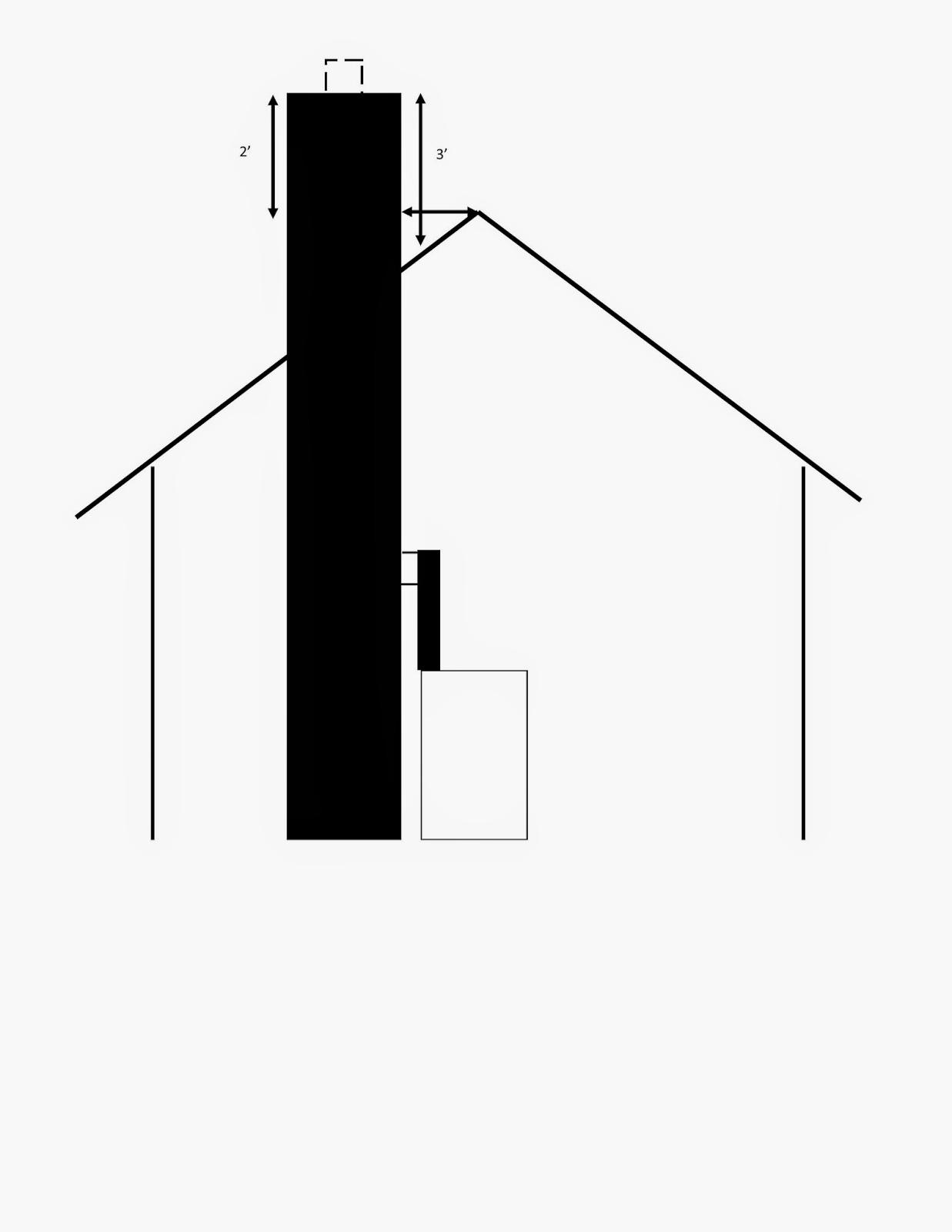
When building, or rebuilding, a chimney the builder should check the height to be sure that it not only conforms to National Fire Protection 211 Standards, which is the standard used in the industry for chimney construction, but also conforms to International Residential Code requirements. Both the standard and the code require that a chimney be three feet taller than the high side of the roof where it exits, and two feet taller than anything (roof, trees, dormers, etc.) within ten feet.  This is the first step in determining what the finished height of the chimney should be. If a fireplace smokes, the height of the chimney could be a factor.

Short flues: Additionally, keep in mind that a short flue (under 12’) may not draft correctly, so the chimney height may need to be extended if a fireplace is on an upper level of the home. It is generally accepted in the industry, although not a code requirement that flues under 12 or


15 feet in height may not draft well.  This may mean that the chimney height needs to be taller than code requires so it will function properly. 

Stack effect: The second factor to consider is the construction of the home. If a chimney is located on a room addition or end of a house, and the main section of the house is taller than the chimney, the house will act like a chimney and pull air upwards. This can cause what is known as “Stack Effect,” and pull smoke back in to the house from the fireplace while it is in operation, and smells when it is not in use.  For this reason, always plan the location of a chimney carefully. 

Trees: If trees or branches are within ten feet of the chimney they can affect draft and cause downdrafts.  If necessary, have trees and limbs cut back further than ten feet away.  

What not to do: Don’t ever add a section of tile flue liner to the chimney to make it taller without extending the exterior brick chase at the same time. Flue liner joints must be below the exterior in order to prevent them from falling over, and if installed incorrectly can be a hazard. 

Homeowners may want to consult with their professional chimney sweep before adding a room addition or constructing a new home to determine the best location for the chimney and fireplace. In some cases, the chimney simply cannot draft correctly due to the location and house construction, and it may need to be built higher, or removed altogether. An alternative fireplace, such as a direct vent gas insert, may be a good alternative to an open wood-burning fireplace in

some cases. Direct vent fireplaces are closed sealed systems that use outside air for combustion and are not as affected by the house construction as open fireplaces. 
___________________________________________________

Marge Padgitt is a CSIA Certified Chimney Sweep and NFI Certified Woodburning Specialist. She is a 30-year industry veteran and has written over 200 articles. Marge is the author of The Chimney and Hearth Pro's Resource Book and The Homeowner's Chimney and Fireplace Manual. See more info at www.hearthmasters.net.